Why Chemical Plants Still Rely on Manual Reports
Chemical plants generate valuable data across production, quality, maintenance, inventory and finance. Yet many still depend on manual reports and spreadsheets to understand daily operations. Explore why disconnected systems create reporting challenges and how data engineering helps manufacturers build a connected, reliable view of plant performance.
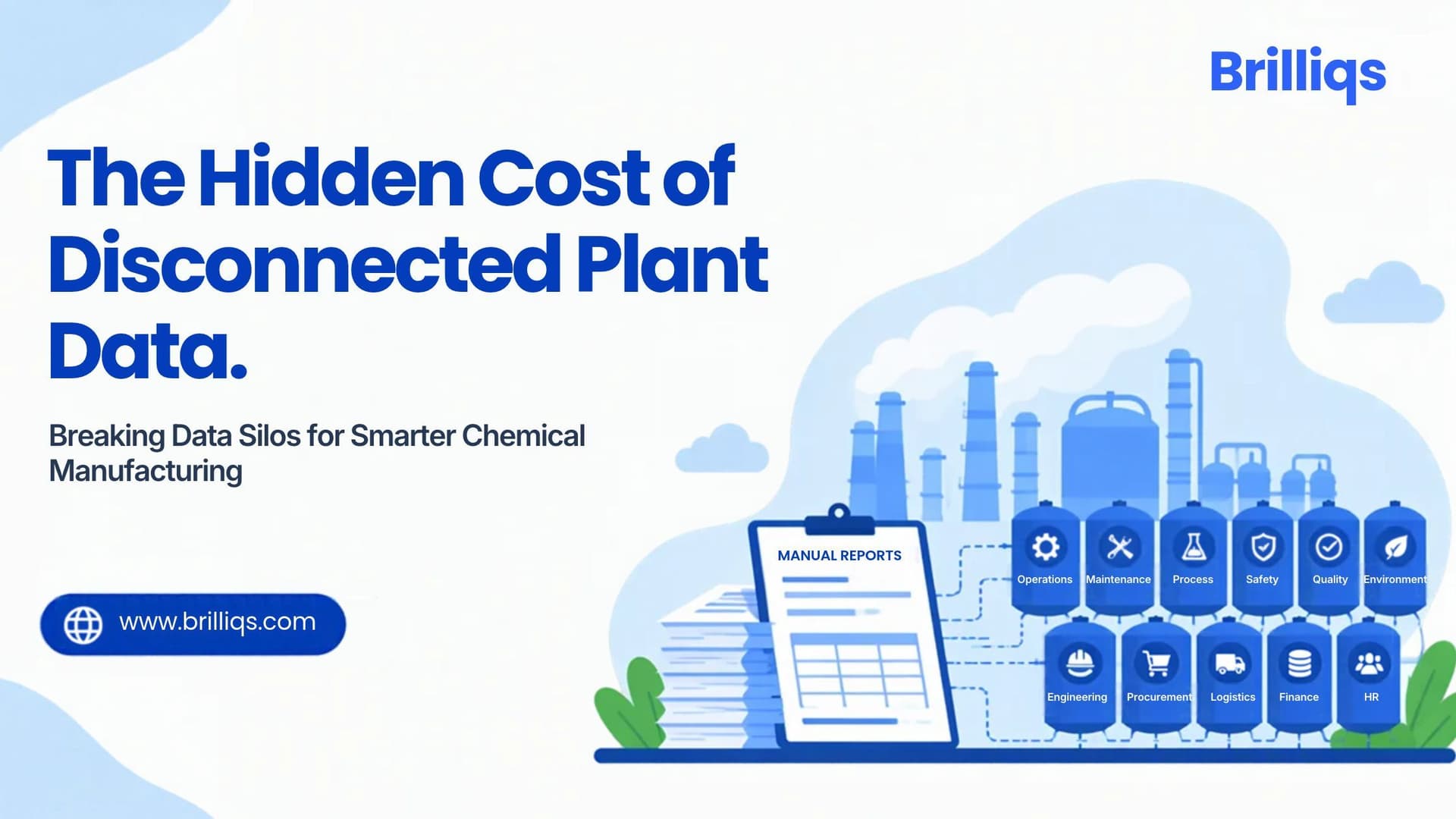
A chemical manufacturing plant can have advanced equipment, automated production lines and sophisticated enterprise software, yet still struggle to answer a simple question: What is happening across the entire plant right now?
The procurement team tracks raw materials. Production monitors batch progress. Quality control manages laboratory results, while maintenance records equipment breakdowns. Finance tracks costs and management relies on reports collected from different departments.
Each team has information about its own activities but bringing everything together can be difficult.
This is the problem of data silos in chemical manufacturing.
When departments store information in separate systems without effective integration, decision makers see individual pieces of the operation rather than the complete picture. Reports may be delayed, numbers may not match and teams may spend hours collecting information that should already be available.
Understanding these departmental data silos is the first step toward building a connected, data driven chemical plant.
What Are Data Silos in Chemical Manufacturing?
A data silo exists when information is stored or managed within a particular department, application or system and is not easily accessible to other teams that need it.
Chemical plants commonly use several systems to manage daily operations. An ERP platform may handle purchasing and finance, a Manufacturing Execution System (MES) may track production and a Laboratory Information Management System (LIMS) may store quality test results.
These systems serve important purposes. The problem arises when they operate independently, without reliable ways to exchange and reconcile information.
For example, the production team may report that a batch is complete, while the quality department still has pending laboratory results. The warehouse may show the material as physically available but the inventory system may not reflect its approval status.
Each department may have accurate information within its own system, yet the organization may struggle to understand the complete situation.
The issue is not necessarily a lack of data. It is the lack of connected, consistent and accessible data.
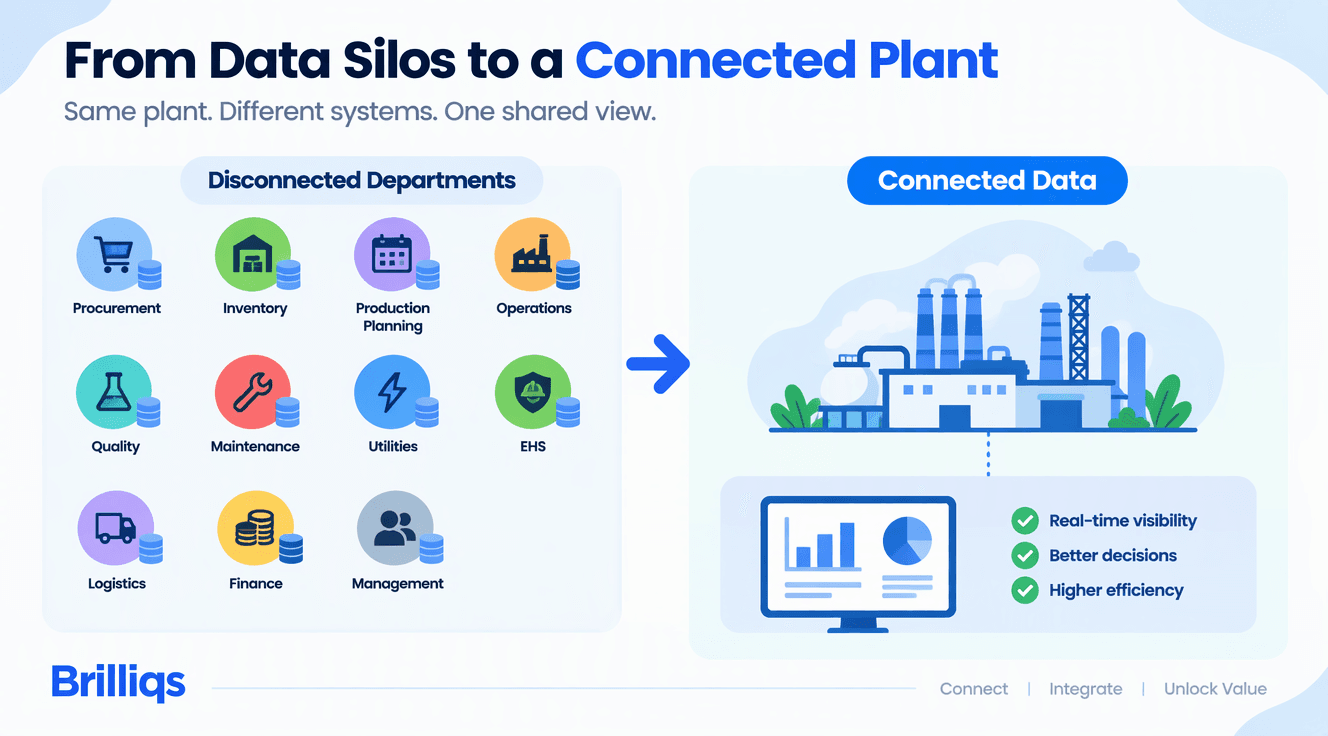
11 Departments, 11 Potential Data Silos
Every department in a chemical plant generates information that contributes to overall operational performance. When these datasets remain disconnected, important relationships become difficult to identify.
1. Procurement: Purchasing Without Complete Visibility
Procurement teams manage suppliers, purchase orders, material costs and delivery schedules.
However, purchasing information may not be connected to real time inventory levels or production requirements.
For example, procurement may place an order based on a planned production schedule without knowing that the schedule has changed.
Data silo: Supplier information and purchase orders remain separate from inventory and production planning.
Business impact: Material shortages, unnecessary purchases and avoidable delays.
2. Inventory: Stock Records That Do Not Tell the Whole Story
Inventory teams track raw materials, intermediate products and finished goods.
Yet physical stock, system quantities, quality approval status and reserved materials may not always align.
A material may appear available in an inventory report but remain under inspection or be reserved for another batch.
Data silo: Inventory records are disconnected from procurement, quality and production systems.
Business impact: Incorrect material availability estimates and inefficient inventory planning.
3. Production Planning: Schedules Based on Incomplete Information
Production planners coordinate batch schedules, equipment capacity, raw material requirements and delivery commitments.
When planning information is not updated with equipment breakdowns, material delays or quality holds, schedules can quickly become outdated.
Data silo: Production schedules are maintained separately from current operational conditions.
Business impact: Frequent rescheduling, missed targets and inefficient resource utilization.
4. Manufacturing Operations: Process Data Stays on the Plant Floor
Production systems collect information such as temperature, pressure, flow rate, batch duration and equipment status.
Much of this information may remain within control systems, SCADA platforms or process historians.
Management may receive only summarized reports rather than timely access to relevant operational data.
Data silo: Plant floor information is disconnected from enterprise reporting and analytical systems.
Business impact: Limited production visibility and slower investigation of performance issues.
5. Quality Control: Laboratory Results Without Production Context
Quality teams test raw materials, intermediate products and finished chemicals against established specifications.
However, laboratory results may be stored separately from batch records and process parameters.
When a batch fails a quality test, investigating the cause may require manually matching laboratory results with production conditions.
Data silo: Quality data is disconnected from manufacturing history and material traceability.
Business impact: Longer investigations, delayed batch release and difficulty identifying recurring quality issues.
6. Maintenance: Equipment History Without Operational Context
Maintenance teams manage inspections, work orders, repairs and preventive maintenance schedules.
Production teams, meanwhile, track output, downtime and equipment utilization.
If these records are disconnected, it becomes difficult to understand how equipment failures affect production performance.
Data silo: Maintenance records are separated from production and process data.
Business impact: Limited downtime analysis and missed opportunities to improve equipment reliability.
7. Utilities: Energy Consumption Without Production Context
Chemical plants consume electricity, steam, cooling water, compressed air and other utilities.
Utility systems may track total consumption without connecting it to individual production batches or processing activities.
This makes it difficult to determine whether changes in energy usage are related to production volume, equipment performance or operating conditions.
Data silo: Utility consumption data is separated from production records.
Business impact: Limited visibility into energy efficiency and production-related utility costs.
8. Environment, Health, and Safety: Important Records Across Different Systems
EHS teams manage safety inspections, incident records, environmental measurements and corrective actions.
When these records are maintained separately from relevant operational information, identifying patterns across departments can become more difficult.
Data silo: Safety and environmental records are fragmented across applications and manual reports.
Business impact: More effort required for consolidated reporting, trend analysis and compliance monitoring.
9. Logistics and Dispatch: Delivery Plans Without Real-Time Readiness
Logistics teams coordinate packaging, transportation, shipment documentation and customer deliveries.
However, dispatch planning depends on accurate information from production, inventory and quality departments.
If these systems are not connected, logistics teams may schedule shipments without a complete view of product availability or release status.
Data silo: Dispatch information is disconnected from production completion and quality approval.
Business impact: Shipment delays, rescheduling and inefficient coordination.
10. Finance: Costs Without the Complete Production Story
Finance teams monitor raw material expenses, manufacturing costs, inventory value and profitability.
But understanding the actual cost of a production batch may require information from several operational systems.
If energy consumption, material usage, downtime and production quantities are maintained separately, cost analysis becomes more complicated.
Data silo: Financial records are disconnected from detailed operational data.
Business impact: Delayed cost analysis and limited visibility into the operational factors affecting profitability.
11. Plant Management: Reports Without a Unified View
Plant heads and senior leaders need to understand production performance, equipment availability, quality, inventory, costs and delivery commitments.
Yet their reports may arrive from different departments at different times, using different definitions and reporting periods.
One report may show planned production, another may show completed batches and a third may include only quality-approved output.
Data silo: Management reporting combines information from systems that may not share consistent definitions.
Business impact: Conflicting reports, slower decisions and limited visibility across the plant.
What Happens When These Data Silos Overlap?
The real problem becomes apparent when one department's issue affects several others.
Consider a chemical plant manufacturing a batch of industrial chemicals.
A critical raw material arrives later than expected. Production planning adjusts the schedule, but the maintenance team has already arranged equipment servicing for the original production window.
After manufacturing begins, the batch requires additional laboratory testing. Dispatch is delayed because the finished product has not yet received quality approval.
Meanwhile, finance records the additional operating costs but management receives the consolidated report only after the reporting period ends.
Each department has handled its own responsibilities, yet the overall process has experienced several connected delays.
Without integrated information, identifying the complete sequence of events requires manual coordination.
This illustrates why data silos are more than an IT problem. They can affect production continuity, inventory planning, quality investigations, delivery performance and financial visibility.
Why Chemical Plants Struggle to Connect Their Data
Several factors contribute to disconnected manufacturing information.
Legacy Systems: Older applications and industrial equipment may not support straightforward integration with modern platforms.
Different Data Formats: Departments may use different equipment identifiers, batch numbers, timestamps and measurement units.
Manual Reporting: Teams may rely on spreadsheets and manually prepared reports to transfer information between systems.
Inconsistent Definitions: Departments may calculate performance indicators differently, creating conflicting results.
Limited Data Ownership: Without clear responsibilities for data quality and governance, errors and inconsistencies can persist.
Solving these challenges requires more than purchasing another software application. Manufacturers need a structured approach to connecting, standardizing and managing their existing information.
How Data Engineering Helps Break Down Data Silos
Data engineering provides the foundation for bringing information from different systems into a consistent analytical environment.
Rather than replacing every departmental application, manufacturers can integrate relevant data while allowing operational systems to continue performing their intended functions.
1. Connect Existing Systems
Data integration brings together information from ERP, MES, SCADA, DCS, LIMS, CMMS and other relevant platforms.
The integration method may involve APIs, database connectors, scheduled pipelines or event based data movement, depending on the system and operational requirements.
2. Standardize and Improve Data Quality
Information must be consistent before different datasets can be reliably compared.
Manufacturers can establish common definitions for equipment identifiers, batch references, timestamps and operational metrics.
Data quality checks help identify missing values, duplicates and inconsistencies.
3. Build Reliable Data Pipelines
Automated data pipelines move and transform information between systems with less dependence on manual reporting.
Depending on business requirements, pipelines can run at scheduled intervals or support more frequent updates.
4. Create a Shared Analytical Foundation
A data warehouse, data lake, or lakehouse can bring relevant departmental information into a shared environment.
This allows manufacturers to analyze production, quality, maintenance, inventory and financial information together without requiring every source system to be replaced.
5. Enable Connected Dashboards
Once reliable data is available, dashboards can provide plant managers and departmental teams with a consistent view of operational performance.
For example, a manufacturing dashboard could bring together batch progress, equipment downtime, quality status and material availability.
The goal is not simply to display more charts. It is to make relevant information easier to access and use when decisions need to be made.
What Chemical Plants Gain from Connected Data
Breaking down data silos can help manufacturers improve several aspects of their operations.
- Better production visibility: Understand planned versus actual production and identify emerging delays.
- Improved quality analysis: Connect laboratory results with batch history and process conditions.
- More effective maintenance: Analyze equipment downtime alongside production performance.
- Stronger inventory control: Improve visibility into material availability, consumption and quality status.
- Energy transparency: Compare utility consumption with production activity.
- Consistent management reporting: Use shared data definitions across departments.
- A foundation for AI: Establish the data quality and integration needed for more advanced analytics and AI applications.
Actual results depend on data quality, integration coverage, operating practices and the needs of the plant.
How Brilliqs Helps Manufacturers Connect Their Data
At Brilliqs, we help organizations build reliable data foundations through Data Engineering, Data Integration, Data Management, Analytics and AIready data solutions.
For chemical manufacturers, this means helping connect information distributed across enterprise applications and operational systems.
By developing automated data pipelines, improving data quality and modernizing analytical platforms, Brilliqs supports organizations seeking a more connected view of manufacturing performance.
Instead of relying entirely on disconnected departmental reports, manufacturers can work toward a consistent foundation for operational analysis, reporting and future AI initiatives.
Conclusion: One Plant, One Connected View
Chemical plants depend on multiple departments, each generating information that contributes to the manufacturing process.
But when procurement, production, quality, maintenance, inventory and finance operate with disconnected data, the organization struggles to see how individual activities affect overall performance.
The solution is not necessarily to replace existing systems. It is to connect the right information, establish consistent data standards, and make reliable insights available to the people who need them.
Eleven departments should not mean eleven disconnected versions of reality.
With the right data engineering foundation, chemical manufacturers can move toward better visibility, stronger coordination and more informed operational decisions.
Brilliqs helps businesses make their data more connected, reliable and useful.