Golden Batch Analytics: Turn Past Success Into Repeatability
Learn how Golden Batch Analytics helps chemical manufacturers identify their best-performing batches, analyze historical process data, understand batch variations and improve production consistency through data-driven insights.
In chemical manufacturing, producing one successful batch is an achievement. Reproducing that same level of quality, yield and efficiency across every subsequent batch is a much bigger challenge.
A batch may deliver excellent results because the raw materials were consistent, the reactor conditions were well controlled and the process followed the right sequence. Yet, when the next batch begins, production teams may struggle to recreate those conditions with the same precision.
The challenge is not always a lack of process knowledge. Often, the information needed to understand the best-performing batch is scattered across control systems, production records, laboratory reports, spreadsheets, and operator logbooks.
This is where Golden Batch Analytics becomes valuable.
By analyzing historical process data, chemical manufacturers can identify their best-performing batches, understand the conditions associated with their success and use those insights to improve future production.
- What Is a Golden Batch?
A golden batch is a reference batch that demonstrates desirable performance against defined production and quality criteria.
Depending on the product and manufacturing process, a golden batch may be associated with:
Consistent product quality
High yield within approved process requirements
Efficient batch cycle time
Stable reactor operating conditions
Minimal process deviations
Reduced rework or material waste
Compliance with product specifications
However, the batch with the highest yield or shortest cycle time is not automatically the best reference.
A batch must meet quality, safety and process requirements. A meaningful golden batch is selected using multiple performance indicators and validated by the appropriate process, production and quality teams.
The objective is to establish a reliable reference for understanding what good performance looks like and which process conditions may help reproduce it.
- Why Is It Difficult to Repeat the Best Batch?
Chemical manufacturing involves several interacting variables. Even when teams follow the same standard operating procedure, batch outcomes can vary.
Raw material variation
Differences in raw material composition, purity, moisture content, or supplier lots may influence reaction behavior and final product quality.
Reactor operating conditions
Temperature, pressure, agitation speed, dosing rates and reaction duration can affect process performance. Small differences may matter depending on the chemistry involved.
Equipment performance
Reactor condition, heat-transfer efficiency, instrument calibration and equipment interruptions may influence how a batch progresses.
Operator and shift differences
Differences in execution, timing, documentation or response to process deviations can make batch comparisons more complicated.
Disconnected process information
The control system may contain temperature readings, the batch record may document material additions and the laboratory system may hold quality results.
If these sources are not connected, engineers may struggle to understand how the different factors contributed to a successful batch.
Without a complete and consistent process history, teams may rely heavily on operator experience and trial-and-error adjustments.
- How Golden Batch Analytics Works
Golden Batch Analytics uses historical production data to compare batch performance, identify meaningful patterns, and establish a reference for future production.
The process generally involves five stages.
Step 1: Collect historical batch data
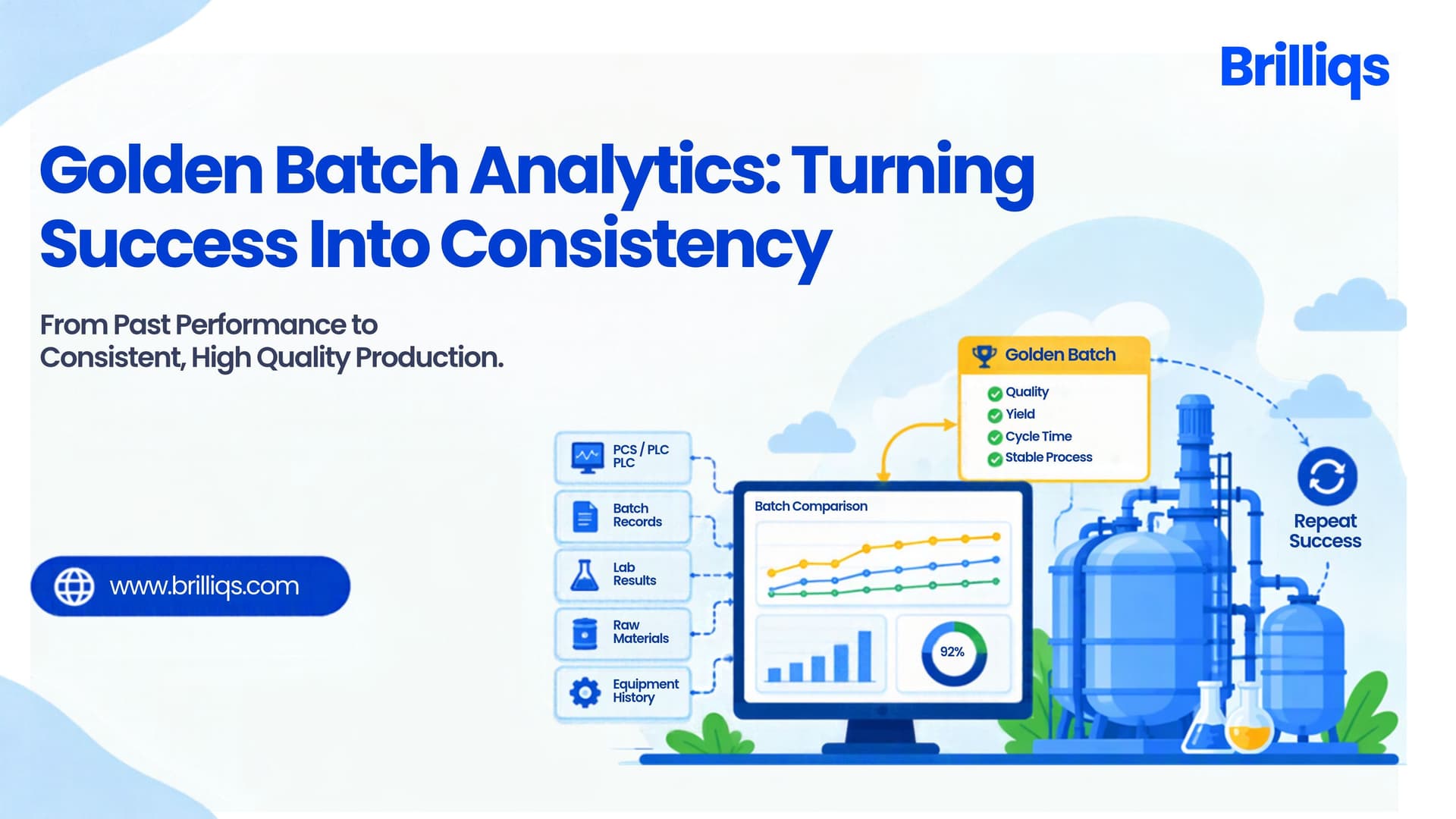
Gather relevant information from available sources, such as:
PLC, SCADA, and DCS process readings
Batch management and MES records
Raw material consumption and lot information
Laboratory quality results
Equipment status and maintenance history
Process alarms and deviation records
Batch start, stop, and completion times
The information should cover the parameters that are relevant to the specific product and process.
Step 2: Prepare and validate the data
Before comparing batches, teams need to check whether the information is complete, consistent and correctly aligned.
This may involve standardizing timestamps, matching batch identifiers, checking units of measurement, handling missing readings and verifying data against source records.
Data preparation is essential because inaccurate timestamps or mismatched batch records can lead to misleading conclusions.
Step 3: Identify the golden batch
Select a batch that meets the required quality and process criteria and demonstrates strong performance against agreed indicators.
For example, a suitable reference batch may achieve the required product specifications with good yield, an expected cycle time and few process deviations.
Process engineers and quality teams should validate the selection before it is used as a reference.
Step 4: Compare other batches with the reference
Analyze how subsequent batches differ from the golden batch.
Useful comparisons may include:
Temperature profiles throughout the reaction
Pressure changes over time
Material addition and dosing patterns
Agitation speed
Reaction and cooling duration
Equipment interruptions
Laboratory results and final yield
Comparing complete process trends can reveal differences that would be missed by looking only at average values or final batch results.
Step 5: Turn insights into process improvements
Once meaningful differences are identified, process and quality teams can investigate potential causes and determine whether changes are appropriate.
Any proposed changes must be reviewed and validated according to the plant's approved procedures, process requirements and safety controls.
The goal is to use historical evidence to support repeatable production not to copy every parameter from a previous batch without considering the conditions of the current run.
- Example: Understanding Why One Batch Performs Better
Consider a chemical plant producing the same formulation in a reactor across multiple batches.
Most batches meet the required quality specifications, but some take longer to complete or deliver lower yields.
The production team identifies one batch that achieved the required quality, a favorable yield and an efficient cycle time.
To understand its performance, engineers compare its process history with several other batches.
Parameter
Reference Batch
Batch With Lower Yield
Raw material lot
Lot A
Lot B
Temperature profile
Within the validated process range
Different temperature trend
Reaction duration
Within the expected cycle time
Longer than expected
Process deviations
No significant recorded deviation
Deviation recorded
Final quality
Meets specifications
Requires investigation
Yield
Within the desired performance range
Below the expected level
Illustrative example only. Actual values and relationships depend on the process.
The comparison gives engineers a starting point for investigation. They can review the raw material characteristics, examine the temperature trend and determine whether the longer reaction time or recorded deviation contributed to the lower yield.
The data alone does not prove the cause. Additional process knowledge, laboratory evidence and controlled investigation may be needed.
However, the team now has a structured way to investigate the variation instead of manually reviewing unrelated records.
- Why Historical Process Data Matters
A golden batch is useful only when the plant can understand why it performed well.
Historical process data helps teams move beyond the final production report and examine what happened throughout the batch.
Understand process trends
Engineers can compare how temperature, pressure, dosing and other relevant parameters changed over time.
Investigate batch variation
Comparisons can help identify recurring differences between high-performing batches and batches that require investigation.
Improve troubleshooting
A structured process history reduces the time spent collecting information from different systems before an investigation can begin.
Support consistent production
Validated reference profiles can help teams understand expected process behavior and identify when a new batch differs significantly.
Preserve operational knowledge
Historical records help retain process knowledge that might otherwise remain in individual spreadsheets, handwritten notes, or the experience of a few employees.
These benefits depend on data quality, suitable analysis, and the involvement of people who understand the manufacturing process.
- The Role of Real-Time Monitoring
Historical analysis explains how previous batches performed. Real-time monitoring helps teams understand how the current batch is progressing.
When these capabilities work together, manufacturers can compare the current batch against an appropriate reference as the process develops.
For example, a monitoring dashboard may display:
Current batch stage and elapsed time
Live temperature and pressure trends
Reference trends from a validated batch
Relevant deviations from expected conditions
Current process status and recorded alarms
This makes it easier to identify differences early and investigate them while the batch is still running.
However, not every difference requires intervention. Process variability must be interpreted in context and any alerts or responses should follow validated procedures and approved operating limits.
A dashboard should support operators and engineers, not replace process control systems or safety interlocks.
- Why Data Integration Is Essential for Golden Batch Analytics
Golden Batch Analytics requires more than a collection of reactor readings.
To understand batch performance, manufacturers often need to connect process measurements with raw material records, equipment history, laboratory results and production outcomes.
When these records remain separate, several problems can arise:
Batch identifiers may not match across systems.
Timestamps may use different formats or time zones.
Measurements may use inconsistent units.
Quality results may not be linked to the correct batch.
Missing readings may affect comparisons.
Historical records may be difficult to retrieve consistently.
A strong data engineering foundation helps address these challenges.
Data integration connects information from relevant manufacturing systems.
Data standardization aligns identifiers, timestamps, units and definitions.
Data quality management helps identify incomplete or inconsistent records.
Historical data storage supports reliable comparisons across batches and production periods.
Analytics-ready data pipelines prepare information for dashboards, statistical analysis and advanced analytical applications.
This foundation makes it easier to analyze batch performance using consistent, traceable information.
- From Golden Batch Analytics to Continuous Improvement
Golden Batch Analytics can become part of a broader continuous-improvement strategy.
Once a reliable reference batch has been established, teams can use it to investigate recurring production challenges.
Potential applications include:
Reducing unexplained batch-to-batch variation
Investigating long reaction or cooling times
Understanding factors associated with yield differences
Identifying recurring process deviations
Improving troubleshooting and root-cause analysis
Comparing performance across reactors or production lines
Supporting process optimization initiatives
Over time, advanced statistical methods and machine learning may help identify relationships that are difficult to detect through manual comparisons.
These techniques require appropriate historical data, careful validation, and domain expertise. Analytical correlations should not automatically be treated as proof of cause and effect.
For processes with changing raw materials, equipment conditions, or product requirements, the reference batch may also need periodic review. A golden batch should remain relevant to the current process and its approved operating conditions.
- How Chemical Manufacturers Can Get Started
Plants do not need to implement a complex analytics platform immediately.
A practical starting approach includes the following steps:
Choose one product or process: Start with a process where batch variation creates a meaningful operational challenge.
Define success criteria: Agree on the quality, yield, cycle time and process requirements that determine a good batch.
Identify data sources: Locate relevant process, material, equipment and laboratory records.
Check data readiness: Validate batch identifiers, timestamps, measurement units and data completeness.
Select a reference batch: Work with process and quality experts to choose a suitable, validated batch.
Compare historical runs: Analyze process trends and investigate meaningful differences.
Track improvements: Monitor whether approved process changes improve performance consistently over subsequent batches.
Beginning with a focused use case helps teams demonstrate value, address data challenges and build confidence before expanding to other products or reactors.
Conclusion: Make Your Best Batch a Starting Point for Better Production
Chemical manufacturers often have years of process data, but the information may not be organized in a way that makes batch to batch learning easy.
Golden Batch Analytics helps turn historical records into a practical reference for understanding successful production. By comparing process conditions, material information, equipment history and quality outcomes, teams can investigate variation more systematically and identify opportunities for improvement.
The real value lies in making successful process knowledge repeatable, measurable and accessible not simply storing more production data.
At Brilliqs, we help businesses connect data from different systems and build reliable foundations for analytics and informed decision making.
Turn historical process data into actionable insights. Build a stronger data foundation for more consistent and efficient chemical manufacturing.