Data Historian vs Data Lakehouse: Key Differences
Discover how data historians and data lakehouses serve different roles in manufacturing. Learn how connecting both technologies helps chemical plants integrate process, production, quality and maintenance data for better visibility and data-driven decisions.
Manufacturing plants generate data every second. Temperature sensors record reactor conditions, machines report operating status, production systems track batches and quality teams document test results. Together, this information can help manufacturers improve production visibility, investigate process variations and make better operational decisions.
But there is a challenge: where should all this plant data live?
Many manufacturers already use an industrial data historian to capture and store time series process data. As their analytics requirements grow, they may also consider a data lakehouse to connect operational information with production, quality, maintenance and business data.
These technologies serve different purposes. A historian is designed primarily to capture and manage industrial process data over time, while a lakehouse provides a broader foundation for integrating, storing and analyzing data from multiple sources.
Choosing between them is not always an either-or decision. For many plants, the better question is how to use both technologies effectively.
- What Is a Data Historian?
A data historian is a specialized system designed to collect, store and retrieve time-series data from industrial equipment and control systems.
It commonly receives information from sources such as:
PLCs and Distributed Control Systems (DCS)
SCADA systems
Industrial sensors and instruments
Reactor temperature and pressure measurements
Machine operating status
Flow, level, and vibration readings
Process alarms and events
For example, a chemical plant may use a historian to record reactor temperature every few seconds. Engineers can review the historical trend, investigate a temperature deviation and compare the reactor's behavior across different production periods.
Historians often provide efficient time-series storage, compression, trend visualization and tools for retrieving process measurements over selected time ranges.
Common uses of a data historian
Process monitoring: Review historical and current process measurements.
Troubleshooting: Investigate equipment behavior and process deviations.
Operational reporting: Analyze trends in temperature, pressure, flow and machine performance.
Process optimization: Compare operating patterns across shifts, production runs or operating conditions.
Operational traceability: Support investigations by preserving relevant process history.
A historian is particularly useful when engineers need reliable access to detailed industrial measurements over time.
However, a historian alone may not provide the most convenient environment for combining process measurements with enterprise data, laboratory results, supply chain information or advanced analytics across the organization.
- What Is a Data Lakehouse?
A data lakehouse is a data architecture that combines the flexible storage capabilities commonly associated with data lakes with data management and analytical capabilities associated with data warehouses.
It can store and process different types of information, including structured tables, event records, files, and historical process datasets.
In manufacturing, a lakehouse may bring together data from:
Industrial historians
ERP systems
Manufacturing Execution Systems (MES)
Laboratory Information Management Systems (LIMS)
Quality management platforms
Maintenance applications
Inventory and supply chain systems
Production spreadsheets and business applications
For example, a manufacturer could combine reactor temperature trends from its historian with raw material lot details from ERP and laboratory test results from LIMS.
This creates a broader dataset for investigating batch performance and understanding how process conditions relate to production outcomes.
Common uses of a data lakehouse
Cross-system analytics: Combine operational and business information in one analytical environment.
Historical analysis: Compare production performance across batches, plants, products, and time periods.
Data engineering: Prepare, standardize and transform information from different systems.
Enterprise reporting: Build dashboards that connect operational KPIs with quality, inventory, and production data.
Advanced analytics and AI: Provide governed datasets for statistical analysis, machine learning and other analytical applications.
A lakehouse is especially valuable when manufacturers need to move beyond isolated equipment readings and analyze how different parts of the operation influence one another.
- Data Historian vs. Data Lakehouse: Key Differences
Although both technologies can store historical data, they are designed around different requirements.
Feature
Data Historian
Data Lakehouse
Primary purpose
Capture and retrieve industrial process data
Integrate and analyze data from multiple sources
Typical data
Time-series measurements, process events, equipment signals
Structured tables, files, events and historical datasets
Main data sources
PLCs, DCS, SCADA, sensors, industrial systems
Historians, ERP, MES, LIMS, maintenance and other systems
Time-series support
Usually a core capability
Supported through appropriate storage and processing tools
Process visualization
Often includes industrial trending capabilities
Usually relies on connected analytics and visualization tools
Cross-department analysis
Depends on integrations and available features
A central architectural use case
Data transformation
Varies by historian platform
Often a major part of data engineering workflows
AI and machine learning
May provide platform-specific analytical features
Can support broader analytical and machine-learning workflows
Typical users
Operators, control engineers, process engineers
Data engineers, analysts, data scientists and business teams
Best suited for
Detailed industrial process history
Integrated, large-scale analytics across systems
The exact capabilities depend on the products, architecture, and implementation. Some historians offer advanced analytics and integration features, while some lakehouse platforms support streaming and low-latency processing.
The key distinction is their primary role, not a strict limitation on what either technology can do.
- Why a Historian Alone May Not Be Enough
An industrial historian can provide excellent visibility into equipment and process behavior. The challenge appears when teams want to connect that information with other business and production records.
Consider a chemical plant investigating why a batch produced less output than expected.
The historian may contain reactor temperature, pressure and operating events. However, the investigation may also require:
Raw material lot and consumption records
Batch formulation and production order
Laboratory quality results
Equipment maintenance history
Production schedule and downtime records
Final yield and rejection information
These details may be stored in separate systems.
Without an effective integration approach, engineers may need to export files, match batch identifiers, standardize timestamps and combine records manually.
This creates several challenges.
Fragmented information
Different teams may have access to different parts of the production story.
Time-consuming investigations
Engineers spend time assembling data before they can begin analyzing the actual problem.
Limited historical comparisons
Comparing performance across products, production lines or plants becomes more difficult when records use inconsistent definitions.
Restricted analytical flexibility
Advanced analytics often requires datasets that combine process measurements with contextual information, not just individual sensor readings.
A lakehouse can help address these challenges by bringing the relevant datasets into a governed analytical environment.
- Why a Lakehouse Cannot Automatically Replace a Historian
If a lakehouse supports large-scale storage and analytics, why not send all plant data directly to it?
The answer depends on the plant's operational requirements.
Industrial historians are commonly designed for efficient time-series collection, process trending, and retrieval of detailed measurements. They may also be integrated into established industrial workflows.
A general-purpose lakehouse does not automatically provide equivalent functionality for every plant environment.
For example, a plant may need to retrieve a detailed reactor temperature trend over several hours, preserve existing process context, and support established operator workflows. Those requirements must be evaluated when designing the overall architecture.
Other considerations include:
Connectivity to industrial control systems
Data collection reliability
Sampling frequency and timestamp accuracy
Data retention requirements
Network segmentation and cybersecurity
Operational resilience
Compatibility with existing plant applications
A lakehouse can support streaming and near-real-time analytics when appropriately designed, but its presence alone does not guarantee real-time monitoring or control.
A data lakehouse should not be treated as a direct replacement for industrial control systems or safety-critical functions. Any architecture must preserve approved control mechanisms, security boundaries and plant safety requirements.
- The Better Approach: Connect the Historian With the Lakehouse
For many manufacturers, a complementary architecture offers the greatest flexibility.
The historian continues to collect and manage industrial process data, while the lakehouse provides a broader environment for combining that information with data from other business and manufacturing systems.
A simplified data flow may look like this:
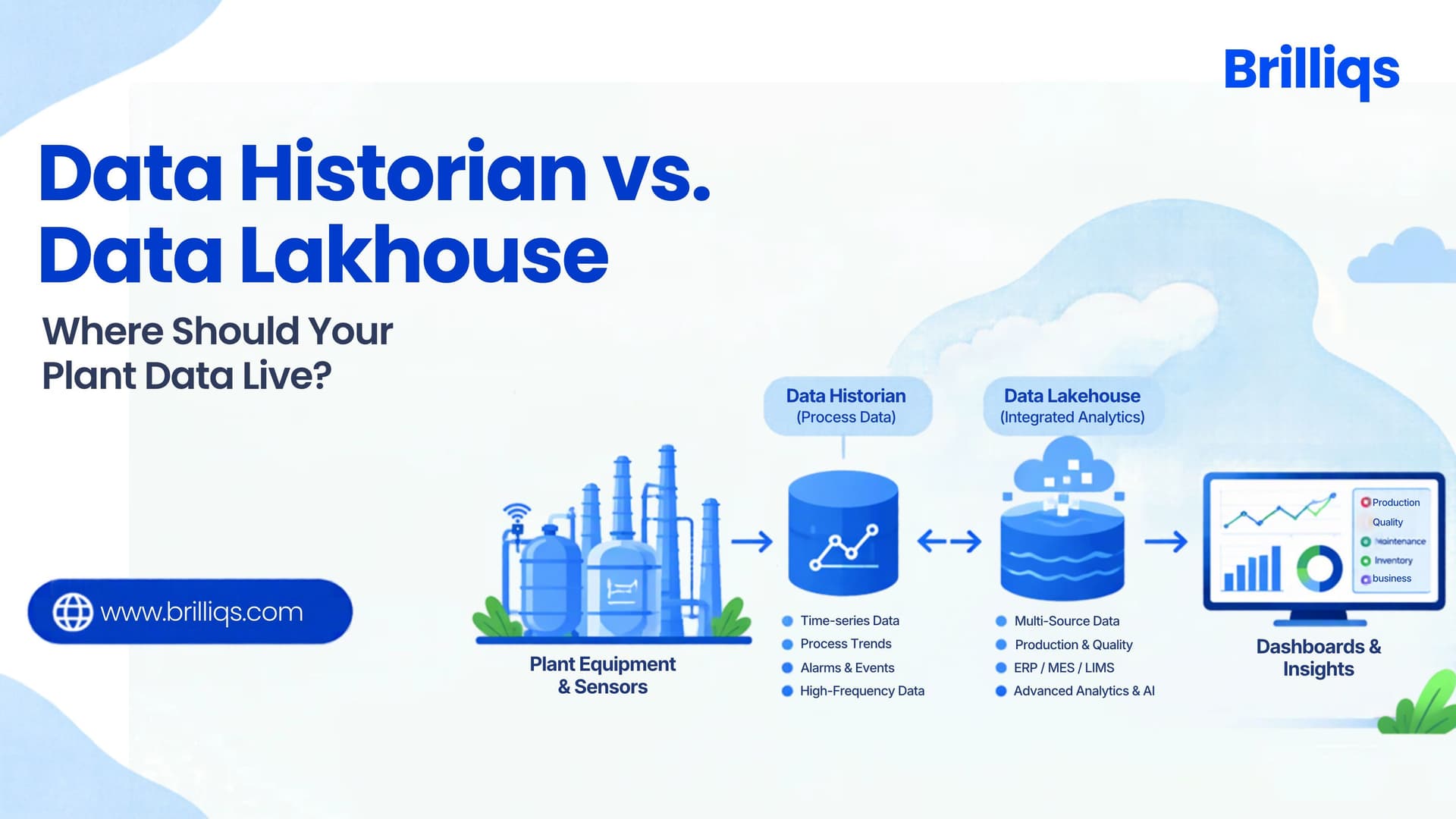
Sensors and Equipment → PLC/DCS/SCADA → Data Historian → Data Integration Pipelines → Data Lakehouse → Dashboards and Analytics
Additional information from ERP, MES, LIMS and maintenance systems can also flow into the lakehouse through appropriate integrations.
This architecture separates operational data collection from broader analytical processing while allowing the two environments to work together.
Step 1: Collect process data
Industrial systems and sensors provide measurements and events to the historian through established collection mechanisms.
Step 2: Transfer relevant information
Data pipelines, connectors, APIs or supported export mechanisms move selected data into the analytical environment.
The integration method should account for source-system capabilities, required latency, data volume and network security.
Step 3: Connect operational and business records
Historian data is aligned with batch identifiers, equipment IDs, production orders, raw material lots and quality results.
Step 4: Prepare analytics-ready datasets
Data engineering processes standardize formats, validate records, handle missing information and establish consistent business definitions.
Step 5: Deliver useful insights
Dashboards and analytical tools help users investigate production performance, compare historical batches and identify potential improvement opportunities.
This approach allows each platform to serve its primary purpose while reducing the need for repeated manual data preparation.
- Example: Connecting Reactor Data With Batch Performance
Imagine a chemical manufacturer that wants to understand why some batches take longer to complete than others.
The historian contains detailed information about reactor temperature, pressure and operating events. The MES records batch stages and production timing. ERP stores material lot information, while LIMS contains laboratory test results.
Individually, these systems provide useful information. Together, they can support a more complete investigation.
With a connected data architecture, the manufacturer could:
Compare reactor temperature profiles across historical batches.
Identify batches with unusually long cycle times.
Review raw material lots and relevant quality results.
Investigate whether recorded process deviations coincide with delays.
Compare findings across similar products and operating conditions.
Provide production and engineering teams with a consolidated analytical view.
This analysis can help engineers identify patterns that deserve further investigation.
It does not automatically establish causation. Process experts must validate findings and determine whether any corrective action is appropriate.
The important change is that teams can investigate using connected information rather than assembling the entire dataset manually for every analysis.
- How to Decide Where Your Plant Data Should Live
The right architecture depends on what the plant needs to accomplish.
Choose or retain a historian when:
Detailed industrial time series collection is a primary requirement.
Operators and engineers rely on historical process trends.
Existing industrial systems already use a historian.
Reliable process data retrieval is important for troubleshooting and traceability.
Plant requirements call for specialized industrial data handling.
Consider a lakehouse when:
Data is spread across multiple manufacturing and business systems.
Teams need to combine process data with production, inventory and quality information.
Historical analysis across products, lines, or plants is becoming difficult.
Data engineers need a scalable environment for transforming and preparing datasets.
The organization wants a broader foundation for analytics and AI.
Consider a combined architecture when:
The historian already supports important operational workflows.
Business teams need a consolidated view of plant performance.
Engineers want to connect process measurements with batch and quality outcomes.
The organization needs both detailed process history and broader enterprise analytics.
Before making a decision, assess data volume, latency, integration requirements, retention, cost, security, governance and the capabilities of existing platforms.
A clear use case should guide the architecture rather than choosing a technology simply because it is newer.
- Where Data Engineering Fits In
Connecting a historian and a lakehouse requires more than moving data from one location to another.
Manufacturing information often has inconsistent naming conventions, different units of measurement, missing values, and separate identifiers for the same equipment or batch.
Data engineering helps make this information usable through:
Integration: Connecting historians, ERP, MES, LIMS, and other relevant systems.
Standardization: Aligning timestamps, equipment identifiers, batch IDs and measurement units.
Data quality management: Identifying incomplete, duplicated, or inconsistent records.
Data modeling: Organizing information around meaningful manufacturing concepts, such as batches, reactors, production orders and quality results.
Governance and security: Defining appropriate access, traceability, and data-management practices.
Analytics enablement: Preparing reliable datasets for dashboards, historical comparisons and advanced analysis.
With a well-designed data foundation, manufacturers can spend less time reconciling information and more time using it to understand operational performance.
Conclusion: Give Every Data Platform a Clear Purpose
A data historian and a data lakehouse solve different but complementary problems.
The historian provides specialized capabilities for collecting and working with industrial process data. The lakehouse offers a broader foundation for connecting that data with production, quality, maintenance and business information.
For many chemical and manufacturing plants, the most practical strategy is not to choose one and discard the other. It is to determine which responsibilities belong in each platform and build a reliable connection between them.
When plant data is integrated, standardized and accessible, manufacturers can move beyond isolated readings and disconnected reports toward a more complete understanding of their operations.
At Brilliqs, we help businesses build reliable data foundations by connecting systems, improving data quality, and preparing information for analytics and AI.
Your plant already generates valuable data. The next step is making it work together.