Architecture that survives scale
We design for the traffic and team size you will have in three years, so today's shortcut does not become next year's rewrite.

Product engineering, application development and legacy modernization by cross functional pods working software every sprint, zero downtime cutovers, SLO backed operations after launch.
Delivery slips for predictable reasons: unclear architecture, slow feedback loops and security bolted on at the end. We remove all three up front.
We design for the traffic and team size you will have in three years, so today's shortcut does not become next year's rewrite.
Two week increments with a live demo, a deployable build and a burn down your stakeholders can read. No six month black box.
Dependency scanning, secret rotation and OWASP checks run on every merge rather than as a penetration test the week before launch.
Strangler fig patterns, dual running and staged cutovers let legacy systems retire quietly while the business keeps trading.
Typical movement across product builds, modernization programmes and managed application engagements.
Typical increase in deployment frequency once CI/CD, test automation and trunk based delivery are in place.
Achieved through right sizing, autoscaling policies and retiring idle services during modernization programmes.
The performance budget we design to for customer facing services, verified with load tests before every release.
Planned outage minutes on our phased legacy migrations, using dual running and reversible traffic shifts.
Figures are averages across delivered engagements. We will benchmark your baseline during the discovery phase.
Multidisciplinary teams covering architecture, delivery, security and operations, so every application we touch is scalable, secure and built to last.
Architecture decisions compound, and the cheap one always comes due. We build fault tolerant, API first platforms with the interface design and backend services to match, so this year's product is not next year's rewrite.
Long delivery cycles hide risk rather than remove it. We design, build and maintain cloud native applications in two week increments, each ending in a deployable build behind automated tests and continuous delivery.
Ageing infrastructure absorbs budget and slows every release that touches it. We map your critical paths, then move them out of the monolith into independently deployable services, one reversible slice at a time.
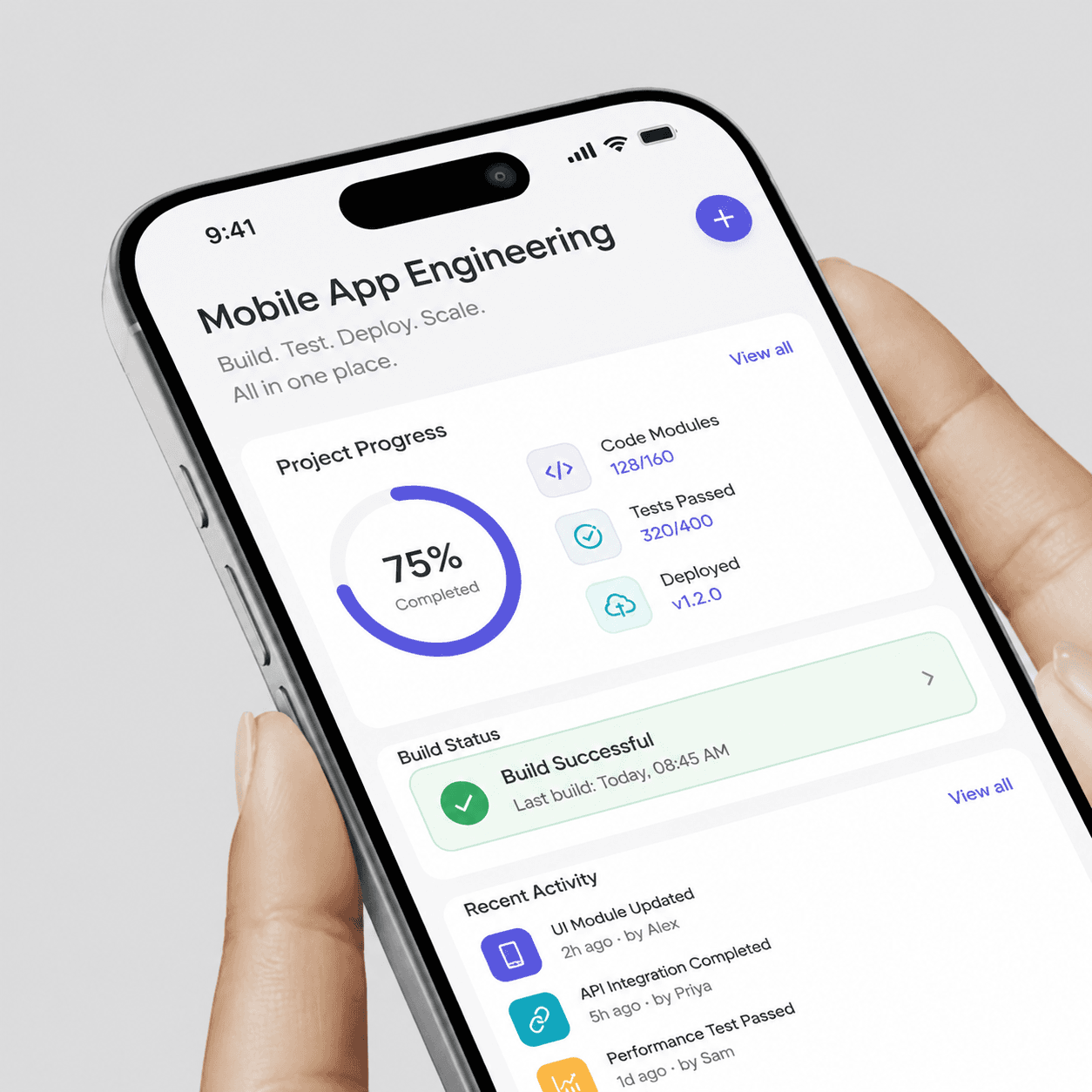
Mobile is where your product meets its worst conditions. We build native and cross platform apps for the reality your users have: patchy connectivity, older devices and device level security requirements.
Security belongs inside the pipeline, not in a report the week before launch. Dependency and secret scanning, OWASP aligned review and least privilege infrastructure run on every merge as normal delivery.
Latency is mostly geography. We push rendering, caching and read paths out to the edge so a user in Singapore gets the response time of one sitting next to your origin region.
Three engagements, each with a dedicated page covering scope, deliverables, technologies and the outcomes we commit to.
A four stage model designed to de risk delivery: every stage ends with something reviewable, deployable and owned by a named person.
We map your current architecture, delivery workflow and constraints, then agree the outcomes that define success for this programme.
Target architecture, environment strategy and a release plan sequenced to reduce risk, reviewed with your architects before build.
Cross functional pods deliver in two week increments behind automated tests, code review and continuous deployment to real environments.
SLO backed operations with monitoring, on call rotation and a documented handover for whichever team owns the system long term.
We map your current architecture, delivery workflow and constraints, then agree the outcomes that define success for this programme.
Target architecture, environment strategy and a release plan sequenced to reduce risk, reviewed with your architects before build.
Cross functional pods deliver in two week increments behind automated tests, code review and continuous deployment to real environments.
SLO backed operations with monitoring, on call rotation and a documented handover for whichever team owns the system long term.
Modern, boring and well supported. We choose technology your team can hire for and operate long after the engagement ends.
Straight answers on codebases, modernization risk, engagement models and who owns what.
Yes, and it is the more common request. We begin with a two to three week assessment covering architecture, test coverage, dependency risk and delivery workflow, then propose a stabilise first plan. Rewrites are recommended only where the cost of maintaining the current system genuinely exceeds the cost of replacing it.
Most clients start with a fixed price discovery and architecture phase, then move to a dedicated pod billed monthly. A pod typically includes a tech lead, engineers, a QA specialist and part time architecture and delivery support, scaled to the roadmap rather than to a fixed template. Our engagement and pricing FAQ sets out how contracts, notice periods and support tiers work.
Security controls sit inside the delivery pipeline: dependency and secret scanning on every merge, OWASP aligned reviews, least privilege infrastructure and environment isolation. For regulated clients we map controls to the relevant framework and produce the audit evidence as part of normal delivery.
We use the strangler fig pattern: new functionality is built alongside the monolith and traffic moves across route by route behind a facade. Each step is independently reversible, so a problem in one slice never forces a full rollback and the business keeps trading throughout. The data behind that system usually needs the same treatment, which is what our data modernization services cover.
You do, from the first commit. Work happens in your repositories where possible, under your branching and review conventions. Infrastructure is defined as code and handed over with runbooks so there is no dependency on us to deploy, scale or recover the system.
Connect with our principal architects to shape a secure, sequenced modernization roadmap for your platform.